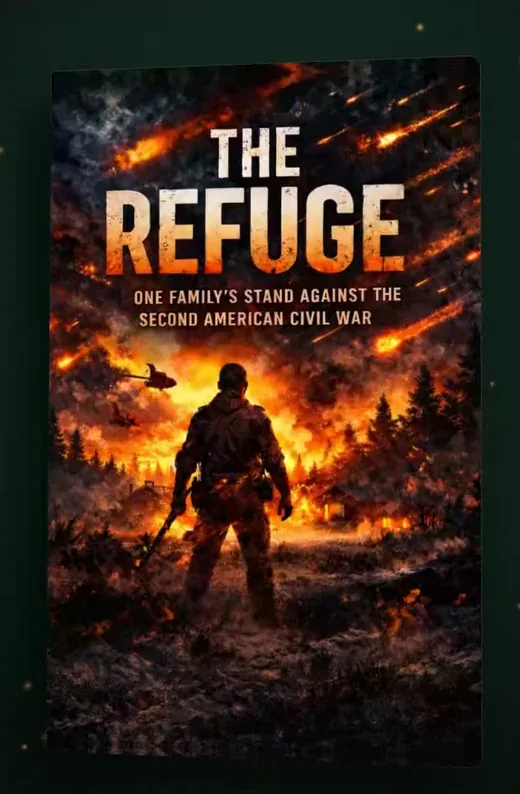
Preface
God is our refuge and strength, a very present help in trouble.
Psalm 46:1
Life is a weather system—bright one hour, brutal the next—and it has a talent for testing the seams of even the best-built marriages. For Jason and Marie Wilder, faith isn’t a garnish they sprinkle on calm days; it’s the spine of their life together. And soon, that spine will be asked to carry far more weight than either of them expected.
They step into a new season on a secluded mountain property in Tennessee—a place they name The Refuge not for romance, but for reason. The land is quiet, yes. It is also honest. It demands calluses. It demands patience. It demands decisions you can’t postpone with polite optimism. Here, the Wilders try to build more than a home. They work toward self-sufficiency, toward stewardship, toward a life anchored in Scripture, prayer, and the kind of fellowship that doesn’t vanish when the lights go out.
But sanctuaries have doors. And doors imply the possibility of what might try to come through.
As the world beyond their ridgelines unravels—orbital debris and cascading failures in the wake of the Kessler Syndrome, economic instability accelerated by cryptocurrency upheavals, widening political fractures, and a nation sliding toward its Second American Civil War—their isolation stops being merely rural. It becomes strategic. It becomes perilous. By 2029, violence is no longer a rumor traveling from city to city; it is a climate. By 2030, the conflict is no longer theoretical.
Jason’s preparation is not paranoia dressed as virtue. It’s a man reading the sky and repairing the roof before the storm arrives. He is capable—sometimes frighteningly so—yet he remains acutely aware of his own shortcomings. He returns, again and again, to prayer and to the hard work of humility. Marie is his counterweight: perceptive, steady, quietly fierce. Where Jason builds walls and plans contingencies, Marie builds people—bonds, trust, courage that doesn’t require an audience.
Together, they begin to draw others toward The Refuge: family, fellow believers, weary souls searching for a place where faith is practiced rather than performed. Community grows—not as a sentimental ideal, but as a necessity. And with community comes responsibility. Marauders. Fires. Floods. Tempestuous weather. Scarcity. Fear. The constant question of how to remain righteous in a world that rewards ruthlessness.
The Refuge is not simply a place on a map. It is a proving ground for love under pressure, belief under threat, and grace in the presence of violence. This story follows the Wilders as they learn—sometimes painfully—that survival is not the highest good.
Faith is.
Prologue
The Battle for Grace
Fear not, for I am with you; be not dismayed, for I am your God; I will strengthen you, I will help you, I will uphold you with my righteous right hand.
Isaiah 41:10
The year 2031.
Twilight bled off the Tennessee ridgeline and pooled in the hollows like spilled ink. Pines stood black and serrated against the last bruise-colored strip of sky, and the mountain retreat called The Refuge held its breath the way a house does when it hears footsteps on the porch that don’t belong.
At the perimeter, a man stood where the tree line thinned into open ground—still enough to be mistaken for another shadow. Silver threaded his brown hair and beard, not as decoration but as evidence: years endured, choices paid for. His eyes were the kind that could soften for a child and harden for an enemy without changing shape.
The handheld at his shoulder whispered static—steady as a heartbeat.
All along the fence line, defenders held their positions. Not soldiers in uniform. Fathers. Mothers. Sons. Daughters. People who’d learned, the hard way, that faith didn’t cancel danger; it simply told you what you were willing to do in the face of it. In the watchtower, two silhouettes scanned the slopes and gullies with disciplined patience, sweeping their lightless gaze across the land like they were reading braille with their eyes.
No one chatted. No one prayed out loud—not now. The prayer was in the restraint—in the way fingers rested alongside triggers instead of curling around them.
The handheld crackled, then snapped into a voice—too quick, too controlled to be casual.
“Movement, southeast corner. Multiple… hold on—” A burst of static chewed the words. “—approaching, low.”
The leader lifted his hand, palm down: stay quiet, stay small. When he spoke into his mic, his tone was level, almost mild, as if he were discussing chores.
“Copy. Eyes on. Nobody gets jumpy.”
Another voice cut in, overlapping—thin with adrenaline. “I count at least six.”
“Six that want to be seen,” he murmured, more to himself than to anyone else. Then, into the mic: “Positions. No lights. No warnings. Hold fire until you can name it.”
A distant rustle moved through the underbrush—an animal sound, except it wasn’t. It had intention. It had weight.
The leader listened as dusk thickened into night. Somewhere in the dark, men were making a decision about other people’s lives.
“Dad,” a young voice breathed over the channel, trying for calm and missing by a fraction. “They’re inside the trees. I—”
“I know.” He didn’t soften the words. He couldn’t afford to. But there was a quiet steadiness in his reply, a hand placed gently on the back of panic to keep it from bolting. “Breathe. Let them come.”
The first burst of movement hit the southeast like a thrown rock—figures surging out of brush, shouting, firing too fast, too sloppy. Muzzle flashes popped and vanished, brief fireflies in the dark.
For a heartbeat it looked like a direct assault.
Then the leader understood: a rattle to pull the eyes.
He turned his head sharply, scanning—not the noise, but the silence beside it. His instincts, honed by years of preparation and the older, harsher schooling of necessity, caught the real threat a second before it arrived.
“West side—” he started, but the handheld drowned him in static.
A second wave breached from another direction, pushing for the interior with the ugly confidence of men who believed the mountain owed them its resources. The Refuge—the gardens, the stores, the shelter, the strategic high ground—was a prize. And prizes, in 2031, were taken.
The leader’s voice snapped clean through the chaos.
“Engage.”
No speech. No sermon. A single word—heavy as a gate dropping.
Defenders answered from behind trees and stone, firing in disciplined bursts. The sound was not cinematic. It was brutal, flat, and final. Gunfire tore the night open and the mountains threw it back in echoes, as if the ridges themselves were arguing with the violence.
Attackers shouted—anger, fear, cruelty braided together. The Refuge responded with something colder: coordinated resistance.
From the higher timberline, two concealed figures moved with unnerving precision, taking targets the way a surgeon takes sutures—quick, exact, without flourish. The attackers faltered as bodies dropped where they didn’t expect resistance to reach.
A brief lull followed—long enough for pain to find him.
The leader keyed his mic. “Status. Talk to me.”
A male voice came back strained and ragged. “Holding—barely. They’re trying to push the gap.”
The leader’s gaze slid toward the lodge, toward the places where his people were. Where children would be huddled. Where prayers would be silent but constant.
“Stay anchored,” he said, and the words held more than tactics. “Use cover. Don’t chase.”
On another channel, someone—one of the women—let out a sharp cry that was part warning, part fury. Her rifle answered in bright, stuttering bursts.
The leader spoke again, clipped now. “Focus. Cover. Comms.”
A beat of static.
Then, terse as a vow: “Copy, Dad.”
The attackers regrouped for a desperate push. You could hear the change in them—the shift from arrogance to panic, from hunting to clawing their way out.
The leader lifted his voice, not into the mic but into the night itself. “Left flank. Now. Pin them—then fold!”
People moved. Not with grace. With necessity. With trust.
For a few seconds The Refuge became a single organism—each defender a nerve, each command a pulse.
The leader didn’t stay behind. He never had. He moved forward into the violence as if he could physically stand between it and the people he loved. He fired in measured rhythm—two shots, reset, two shots—breathing through the recoil, tasting cordite and cold air, listening for the tiny changes that meant someone nearby had fallen.
Then a lone gunshot cracked—different from the rest. Cleaner. Deliberate.
The leader felt the impact before he heard it. A hot, stunning punch that stole air from his lungs and turned his legs briefly unreliable. He staggered, one knee dipping toward the earth, a grimace carving hard lines into his face.
His hands did not let go of the rifle.
Pain tried to reduce his world to a single point, but defiance—old, familiar, almost devotional—burned hotter. He forced breath in. Forced his vision to sharpen. Forced his finger to obey.
Not yet.
His body betrayed him in increments—strength draining, sight smearing at the edges—but his will stayed braced like a door barred from the inside. He kept firing, steady as a metronome, each round a refusal.
Around him, the battle continued: shouting, scrambling boots, the wet thud of bodies hitting ground. The Refuge held. The attackers wavered. Somewhere, someone screamed his name—either in warning or prayer.
The leader’s vision dimmed further, night swallowing the last outlines of trees and faces. He tasted iron. He felt the earth’s cold seep into his knee.
In that narrowing tunnel of sound and shadow, a single truth rose, stark and calm: the fight might go on without him.
His grip tightened one last time, not in anger, but in resolve—like a man closing his hand around a promise.
And then, as darkness pressed in and the handheld hiss became distant as wind, he admitted what his body already knew: he was slipping.
He didn’t know if he’d wake again. He only knew the others had to keep standing.
Keep reading: Chapter One, A New Beginning
Chapter One
A New Beginning
Therefore, my beloved brothers, be steadfast, immovable, always abounding in the work of the Lord, knowing that in the Lord your labor is not in vain.
1 Corinthians 15:58
Spring 2024.
Jason Wilder stood tall and broad-shouldered, rugged in a way that couldn’t be purchased—only earned. Years of hard work had weathered his skin and set quiet strength in his deep blue eyes. His salt-and-pepper hair had thinned with time, but it only sharpened the impression of steadiness he carried like a mantle. He was the kind of man who made others feel safer simply by standing nearby.
Marie Wilder was his counterbalance—grace shaped into resilience. Her radiant smile, framed by soft auburn curls, could soften even the hardest day. Her expressive green eyes held the kind of wisdom that grows from loving people through seasons of difficulty. Petite in stature, she carried quiet dignity like a flame that refused to be blown out.
Together, Jason and Marie had learned to move as one—rooted in faith, shaped by endurance, and strengthened by love.
At their heels trotted Wilson, their Alaskan Malamute—loyal, watchful, and forever convinced he was still a puppy. He had been with them for years, not merely a pet but family: companion, protector, and comic relief when life needed it most.
Jason and Marie stood at the edge of their newly acquired land, hearts swelling with a mix of excitement, gratitude, and sober awareness. Before them lay one hundred and fifty acres tucked into the Tennessee mountains—lush slopes, tall timber, and the kind of quiet that made a person feel small in the best way.
The land had once hosted a small Christian camp. Remnants remained—structures weathered by time, gardens half-tamed, paths worn by years of boots and laughter.
The main lodge was impressive: sixteen bedrooms—eight below, eight above—a large kitchen with commercial-grade appliances, and a dining space big enough to feed a crowd. A separate meeting room sat adjacent, the kind of space that could hold prayer, teaching, family gatherings, or hard conversations that needed privacy.
Outbuildings dotted the property—some serviceable, others sagging with neglect. Herb and vegetable gardens lay scattered like forgotten promises, their beds begging for care.
Toward the back stood a shooting range and a tall watchtower—a relic of the past. It had once served as a Forest Service fire watchtower in the 1950s, later repurposed by the camp owners into a zipline platform. A log fence surrounded the retreat, weathered but stubbornly standing.
Years before retirement, the Lord had opened doors Jason never could have forced on his own. He’d been blessed with work he enjoyed and the kind of compensation that allowed him to prepare with quiet intention for scenarios most people dismissed as paranoia. He invested in reliable equipment, tools, and systems—not because he craved fear, but because he believed stewardship mattered.
A verse had been lingering in his mind lately:
“The heart of man plans his way, but the LORD establishes his steps.” (Proverbs 16:9)
Jason took comfort in the balance of that truth: plan with diligence, but hold those plans loosely—because God was always the final Author.
Only three weeks into retirement—and newly closed on the property—Jason felt the itch of purposeful work. After nearly forty years as a project, program, and portfolio manager—ten of those years in the U.S. Navy—he approached the retreat like he approached everything else: with structure, sequencing, and clear priorities.
After the Navy, he’d led large-scale efforts for hospitals, corporate banks, and government-sector consulting. Now, instead of boardrooms and stakeholder meetings, he had a lodge, a fence line, and a future that felt increasingly uncertain.
That evening, he and Marie sat together with blueprints and notebooks spread across the table. The quiet hum of possibility filled the room.
Marie breathed out, looking out toward the darkening tree line. “Jason… this land is a dream. But the work is enormous. Where do we even begin?”
Jason studied the property map, then met her eyes. “The lodge first. Dreams are beautiful, but we need a functional home. A real base.”
Marie chuckled. “So our ‘new beginning’ starts with a construction zone.”
“It starts with a sanctuary,” he corrected gently. “And sanctuaries take work.”
She gave a small nod. “Staying connected matters too, right? Even out here.”
“Absolutely,” Jason said. “Starlink should keep us connected as long as the world stays… the world.”
Marie’s expression sobered. “And security?”
Jason didn’t pause. “Cameras. Motion lights. Sensors. A system we can monitor from the lodge. A plan we practice.”
Marie reached across the table and took his hand. “I trust your judgment. I want our home to feel like peace—not like fear.”
“That’s the goal,” he said, squeezing back. “Preparedness without paranoia.”
They talked through priorities: repairs, water and sanitation, power, gardens, a woodshop, a smokehouse, a backup generator, and a place to worship. Their plans weren’t just practical—they were personal. Visions of a simple worship room with a wooden cross and a shelf of well-worn Bibles mingled with the dream of hot cocoa beside a wood stove while snow drifted outside.
Later, when Marie’s worry surfaced—quiet but real—Jason didn’t dismiss it.
“Are we trying to do too much too soon?” she asked.
Jason drew a slow breath. “I just don’t want to miss anything. I want us ready.”
Marie smiled—warm, steady, certain. “We’ll find our way. Together. ‘I can do all things through him who strengthens me.’”
Jason’s throat tightened, gratitude rising like a tide. “Your faith steadies me,” he admitted.
Outside, the Tennessee mountains stood silent and watchful. Inside, Jason and Marie weren’t simply building a home.
They were laying foundations for a refuge.
Chapter One ends here.
From The Refuge, Book One, as printed. © 2026 Michael Bath. Unless otherwise indicated, Scripture quotations are from the ESV® Bible (The Holy Bible, English Standard Version®), © 2001 by Crossway, a publishing ministry of Good News Publishers. ESV Text Edition: 2025. The ESV text may not be quoted in any publication made available to the public by a Creative Commons license. The ESV may not be translated in whole or in part into any other language. Used by permission. All rights reserved.