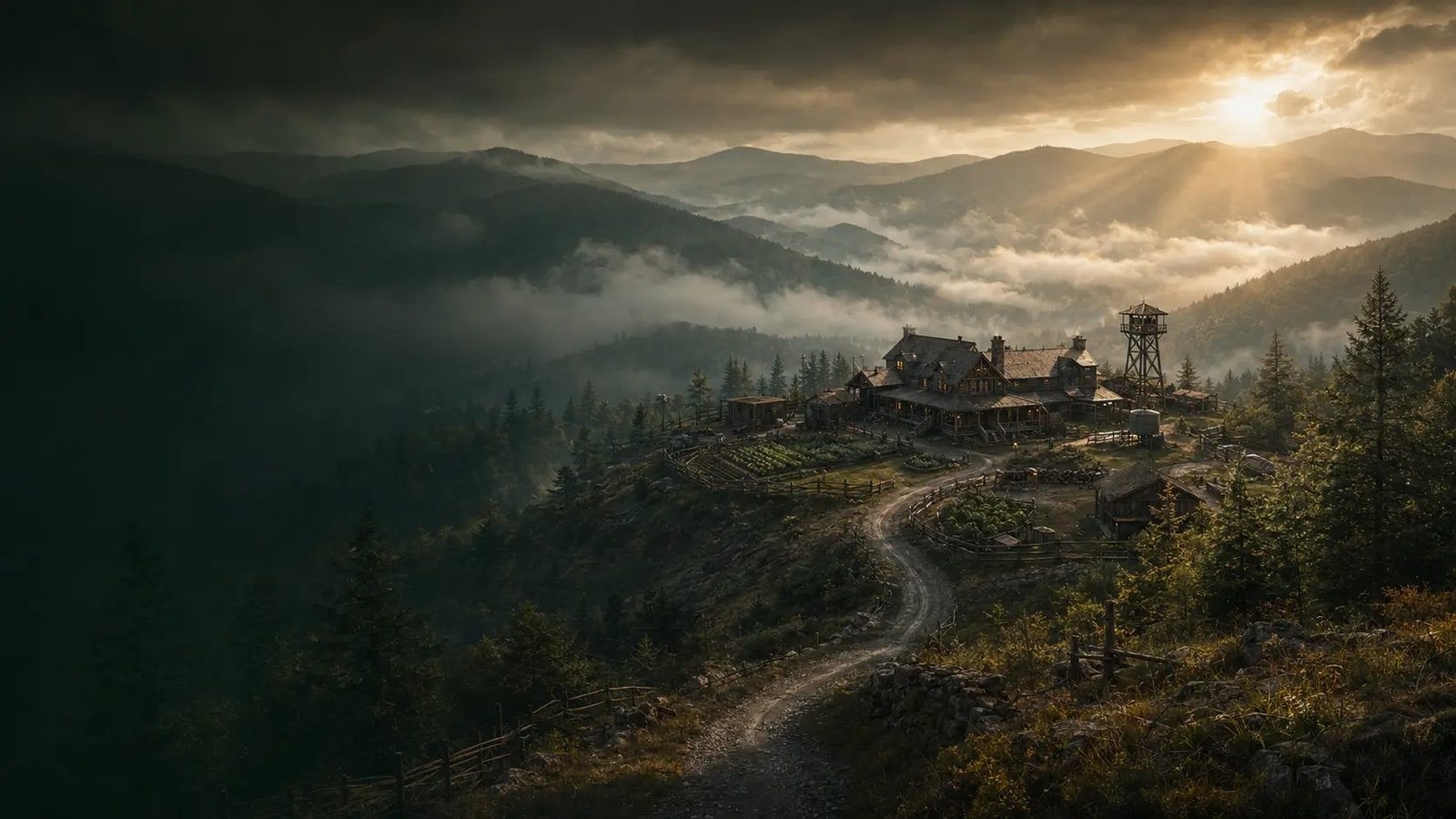
Earlier that fall, before the bell learned how alarm could wear the same voice.
Wilson did not bark. He growled as if the dark itself had climbed the mountain and come to listen at the walls.
The sound pulled Jason out of sleep before the first light reached the ridge. For one blind second he came awake the old way—hand moving before thought, nerves snapping taut, the body trying to rise as if it still belonged to the man he had been before blood and fire had rewritten it.
Then the pain arrived.
Chest first. Hip next. Deep, familiar, punitive. His body had its own weather now, and morning always came with a barometric report.
He lay still long enough to hear the room. Wind at the eaves. The low banked tick of the stove heat fading in the lodge. Wilson again—closer this time, low in his throat, no wasted noise. Not alarm. Warning.
Marie’s side of the bed was already cold.
Jason turned his head. The birchwood wheelchair waited where it always waited, patient as a truth he no longer argued with before dawn. In the dark it looked plain, almost gentle. In daylight it was less merciful. It told him what he could not carry and how much strength still cost.
The wounds that put him in it had been earned at the end of the last siege, when blood, smoke, and bad ground had left his hip and ribs with a debt they collected every morning. The chair was not surrender. It was arithmetic. It let him spend strength where leadership required it instead of wasting it on pride before sunrise.
He swung himself over, set his weight, and felt the old stab in his left side like a blade remembering its work.
He wheeled to the door and opened it onto the hall.
Cold air had found its way inside somewhere. The corridor smelled of pine boards, lamp smoke, and the faint medicinal ghost that clung to old places where too many people had nearly died and not quite. At the far end, the front door stood cracked open. Jack was there in jeans and a thermal shirt, one hand braced on the jamb, a radio hanging loose at his side.
Jack turned at the sound of the chair wheels and said, “You need to see this.”
Jason did not ask what this was. He already knew enough from Jack’s face. The young man looked composed, but it was the kind of composition built in a hurry, something nailed together just before the roof came off.
Wilson stood on the porch, broad back rigid, silver fur lifting along his shoulders. He did not glance back when Jason rolled up beside him. His eyes were fixed on the ridge.
Jason followed his gaze.
At first the mountain looked ordinary in that predawn way—one long black shape shouldering up against a sky not yet committed to morning. Then his eyes adjusted, and the ridge changed.
Fires.
Not one or two. Not the accidental glow of some lost traveler too cold to be wise.
Too many.
They burned at uneven intervals along the far rise and down one shoulder of the mountain, orange pricks in the dark, each one small on its own, together forming something far more deliberate than comfort. Jason counted without meaning to. Lost the number. Counted again.
A dozen, at least.
Maybe more.
Jack stepped onto the porch beside him, careful not to speak too fast. “There were three just after midnight. I checked again at one and saw five. Then more started showing up on the lower line.”
“The lower line” meant the approach nearest the creek.
Jason kept looking. “They’re not grouped for warmth.”
“No.” Jack rubbed a thumb against the radio body. “That’s what bothered me.”
Bothered was too mild a word. The fires were spaced badly if the people huddled around them cared only about heat. Too much ground between some. Too neat a spread on others. One sat near the old game trail that ran down toward the west fence. Another glowed above the shallow cut where runoff fed the creek after heavy rain.
Not random, then.
Observed.
Wilson’s growl deepened. Somewhere out there, a log shifted in a fire and sent a brief spray of sparks upward. Jason watched the sparks vanish into black.
“How close?” he asked.
Jack lifted his chin toward the lower slope. “Closest one’s near enough to smell our chimney smoke if the wind turns. Maybe closer.”
Jason’s gaze moved across the clearing. Beyond the lodge and cabins, past the dark block of the tool shed, the small chapel stood in silhouette. The bell frame beside it was just visible, the rope hanging still. Sean had hung that bell in the spring, salvaged off a Pennsylvania church that no longer needed warning, and it had taken the ridge less than a season to start calling the whole place by its sound.
In another ten minutes, maybe fifteen, somebody would want to ring it for morning prayer.
Today, the sound would not be worship.
It would be information.
Jack followed his eyes and understood immediately. “I already told them not to ring it.”
Jason nodded.
No birdcall yet. No proper dawn. Only the wind moving along the boards under Wilson’s paws and those unnatural little mouths of fire watching from the ridge.
Jack said, “You think they know exactly what this place is?”
Jason kept his voice level because fear was contagious and Jack already had enough to carry. “I think somebody knows enough.”
Jason saw it then—not fully, not in some theatrical revelation. Just a pattern tugging at the edge of the mind. The fires did not circle the Refuge cleanly. They did something worse. They marked sightlines. Approaches. The ways a stranger would study a house before deciding whether to knock, beg, buy, or break.
Jack shifted his weight. “Sean’s making another pass near the lower gate.”
Jason’s jaw set. “Alone?”
“For the moment.”
“Not again.” Jason took one last look at the ridge. “No one walks it alone from here on.”
Jack nodded. “Already told Aaron.”
That was something. Small. Useful. Real.
Jason backed from the porch. “Come inside.”
The kitchen met him in layers: stove heat, coffee pulled a shade too far toward bitter, bread already edging stale, the wool-and-wood smell of a place being lived hard and honestly.
Marie stood in the pantry doorway with the ledger open against one palm. She had not waited for his answer to begin worrying; the numbers were already assembled.
Flour. Salt. Lamp oil. Soap. Dried beans. Preserved venison. Rice. Coffee measured like medicine. Firewood. Kerosene. Bandages. Antibiotics in Ava’s small, neat hand.
Nothing looked meager. It all looked countable. It looked finite.
From the far hall, a baby cried with sudden outraged force.
Jason Jack. Ava and Jack’s boy, named for his grandfather.
Ava had taken to calling him JJ before he was a week old, because a house that already answered to a Jason and a Jack could not spare a third of the same name, and because two letters fit a child who did not yet fill out his blankets.
The sound cut cleanly through the lodge. A floorboard answered, then another—Ava or Jack going to him in the half-dark.
Marie closed her eyes for one brief beat, listening, then looked back down at the ledger.
Jason said, “How long have you been up?”
“Long enough.” Her pencil tapped once beside the flour column. “If we are counting only the people already under this roof and in the cabins, we can make winter. Tight, but we can make it.”
Jason waited.
She looked up then, green eyes too tired for diplomacy. “As a community, yes. As a beacon, no.”
The baby cried again. Harder this time. A short, furious sound of new life refusing inconvenience.
Jason turned his head slightly toward the hall, then back to the ledger.
Marie saw where his mind went. “That’s the point,” she said. “It stopped being only us.”
The Refuge had outgrown the shape of a private plan. Chapel. Schoolroom. Library. Gardens. Cabins. A perimeter. Shared labor, shared prayer, shared hunger. Places built that way did not stay hidden.
From the upper room, Jason could read the place as obligations laid on a slope: the lodge on the high center; the chapel and bell frame east of the yard; the library tucked into the lodge’s north corner; the main gate down toward the lower meadow; the service lane offset south where the road pinched narrow; generator shed and wood stacks on the west shoulder; creek and water point below; the old laundry cabin on the east path, far enough from the nursery to matter if sickness came. Every path crossed another somewhere. Every path could become a weakness if watched long enough.
Word would find them. It already had.
Jason thought of the stolen truck they had dragged home months ago, and of the second CB hidden beneath its dash, the little green light still awake after everyone thought the road threat had ended. Ben had killed the power and said the thing none of them wanted to hear: maybe it had listened. Maybe it had led someone home.
Jason had logged the warning, meant to trace it, then buried it beneath louder emergencies. The ridge fires made the old green blink feel less like an oddity and more like a seed finally breaking ground. Maybe the first breadcrumb had not been smoke, song, or mercy at all. Maybe it had been that quiet little eye, waking in the dark.
Or it had not been the radio at all. Caleb had slept under their roof for a season and eaten at their table and walked their fence line with the easy attention of a man learning a place rather than living in it, and when Tom finally opened the notebook he had left behind, it held the gate angle, the springhouse, the aid room, the blind pocket near the east cabins, and the hatch to the cellar under the lodge marked with a small x and the word children.
They had never found him. Jason had stopped assuming that meant he was dead.
The radio room had gone quiet in its own way. They still opened the scheduled HF windows out of discipline, and Sara still kept the wall map with its pencil marks for other families, other outposts, other voices that had once been turning into routes. For eleven days nobody had answered any of them. Jason had not decided yet whether that meant the country had gotten quieter or that something had gotten between them and everyone who used to speak.
Jason said, “We don’t know who’s out there yet.”
Marie’s mouth tightened. “We know some of what’s out there.”
He did not argue. Cold. Hunger. Fear. Maybe sickness. Maybe calculation. Usually all in the same body.
Jack shifted near the table. “At least one of them was close enough to map the creek side.”
Marie glanced at him. “You saw someone?”
“No. I saw where a fire was set.” Jack hesitated, as if he knew how ugly this sounded in a kitchen with coffee on the stove. “It wasn’t chosen for warmth. It was chosen for visibility.”
Marie absorbed that without flinching. Her grip tightened slightly on the ledger.
Need did not stop being human. It also did not stop being dangerous.
Marie met his eyes. There was no accusation in them. Only sorrow at how true the sentence was.
From the hall, the baby quieted for a moment. Then came the murmur of Ava’s voice and Jack’s low reply, too indistinct to make out.
The ordinary sounds of a living house.
The ridge fires felt closer because of them.
Marie turned the ledger so Jason could see the lower margin where she had already written two columns in smaller script.
Aid possible.Aid sustainable.
No numbers yet beneath either heading.
He stared at the blankness. Jack, reading over Marie’s shoulder, went very still.
Jason asked, “You started that already?”
Marie gave a tired little shrug. “Somebody had to.”
He almost said not before dawn. Almost said not without me. But the protest died before it formed. The truth was simpler and harder: she had seen the same mountain, heard the same dog, counted the same baby crying in a house already too full of beloved people.
This was not fear talking. It was stewardship.
The front door opened hard enough to strike the stopper.
All three of them turned.
Sean came in carrying field glasses in one hand and cold air in with him. Mud stippled the cuffs of his jeans. His face had the wind-struck look of a man who had gone to verify something and found he’d arrived too late to verify anything at all.
He looked from Jason to Marie to Jack and said, without preamble, “They’re already moving.”
No one spoke.
Sean set the field glasses on the table, breath still rough from the slope. “Not all of them. But enough. Coming down from the ridge in twos and threes. Pots. Blankets. Kids.” His throat worked once. “Dad—”
He didn’t need to finish.
Jason was already turning his chair toward the back passage that led to the upper observation room.
The upstairs room had once held camp supplies, then youth-counselor binders. Once the country worsened, it became something plainer and more honest: optics, maps, spare batteries, the tools of caution civilized people preferred not to name.
The field glasses narrowed the world into pieces.
A woman wrapped in a blanket with a boy fused to her side—Ruth Hale, though Jason did not yet know her name.
A pregnant woman picking her way down the slope with one hand at the small of her back and one on a stick somebody had cut in haste.
An old man carrying a dented pot as if broth might buy him another day.
And farther off, at the break toward the creek, a man in a dark oilskin coat standing longer than hunger required, not looking at the line so much as the land.
Sean lowered the glasses. “That one’s wrong.”
Jack took them and looked for himself. “Yeah.”
“He’s counting,” Jason said.
Nobody answered because nobody needed to.
Sean shifted to the west window. “More out there than I thought. Another dozen hanging back.”
“Armed?” Jason asked.
“Can’t tell. Coats hide waistlines. But they’re spread for sight, not company.”
Jason took the glasses again and saw it: the fires had marked the approaches in the dark; the bodies were holding them in daylight.
From below, the muted clatter of a pot lid carried upward. A child coughed. Somewhere in the camp, a woman raised her voice to call somebody back into line.
Not an army, then.
Which somehow made it worse.
Jason lowered the glasses. “Kitchen. Now.”
By the time they got back to the kitchen, the others were already gathering there, drawn by the same instinct that pulls families toward doorways when the weather changes.
Jason did not waste words. “The line is coming to the gate. We set the terms now or the gate will set them for us.”
Jack folded his arms. “No one crosses the inner fence.”
Marie said, “No one?”
“No one we have not cleared. Sick, armed, scouting—no.”
Ava lifted her eyes. “If they’re freezing?”
Jack looked at her, then away. “Same answer until we know what we’re standing in.”
Marie’s mouth hardened. “We cannot pretend those people are none of our concern before God.”
“And we cannot answer before God if we turn this place into a breach and call it mercy,” Jason said.
The room locked around the words.
Sean stepped in before the silence could split. “Aid point outside the main gate. Hot broth first. Bread if we can stretch it. Names, households, symptoms.”
Sara nodded at once. “Ledger starts now. Names. Ages. Kin. Origin. What they say. What they avoid.”
Aaron looked at Jason. “Water?”
“Controlled,” Jason said. “No one at the creek without one of ours.”
Amber said, “Women and children first for triage or the whole line goes ugly before breakfast.”
“That isn’t sentiment,” Marie said. “That’s physics.”
Ava braced a hand on the table. “I can work the far end. No contact unless I call it. JJ stays inside.”
Jack started to object, saw her face, and changed battles. “Fine. But nobody plays hero.”
Ava’s answer came tired and flat. “None of us do.”
Jason looked around the table. His sons — Sean with the field glasses still in his fist, Aaron with creek mud to the knee. His daughters — Amber already thinking in triage, Ava who should have been sitting down. Sara beside Sean, Marianne behind Aaron’s chair, Jack at Ava’s shoulder with a father’s jaw on a son-in-law’s face. Kyle in the doorway where he always stood, because a man who had come home with them from a thousand miles of bad road had earned the right to stand wherever he liked. Every one of them his, one way or another. And he saw the truth all at once: the Refuge had stopped being a hideout. It was a machine now, and machines failed at their seams.
“We help,” he said. “We do not invite chaos inside the fence and baptize it as compassion. We feed what we can. We record everything. We keep our children clear of the line. We move like people who intend to survive this without becoming less than we were.”
“And get word out to our own,” Jason added. “Tom’s camp, Gabe and Bella, Ben and Selena, Miss Fran. If the roads are filling, they hear it from us before rumor reaches them—and they hear that this gate is theirs the day their own ground stops holding.”
No one argued.
Outside, the dog barked once toward the front gate. Wilson did not waste sound.
Aaron went to the window and looked out. “Too late for any more planning.”
Jason wheeled across the kitchen and saw them. The first line had already formed.
It did not look like an invasion. It looked like need with hands.
They moved in a controlled rush—pots, crates, blankets, names already being written before the first cup was poured. Jason felt the old instinct to seize the whole scene by force and knew force would not solve the morning.
By the time he reached the gate, the crowd had shape and eyes.
Ruth Hale stood near the front with the boy tucked against her side, both of them shivering in the damp cold. The pregnant woman waited three places back, jaw clenched against discomfort she had no room to complain about. A child with bare hands kept wiping his nose on the sleeve of a coat too thin for the morning, watching every ladle as if it were a court verdict. Behind them, men stood with hats in hand, with shoulders bent, with expressions that moved between hope and humiliation. And farther still, the dark oilskin man watched the fence rather than the broth.
Jason saw hunger. He saw sickness. He saw fatigue.
He also saw attention.
Marie came up beside him carrying the first stack of cups. Her face softened when she took in the line, then set again. Mercy and caution, both arriving on time.
Jason kept his voice low. “Outside the gate only.”
She nodded. “I heard you the first time.”
The latch opened just wide enough to let Aaron and Amber set the tables, not an inch more. Jack and Sean took positions where kindness could still be seen and panic could still be stopped.
For a few seconds the whole mountain listened.
Then a little girl halfway down the line—mud at her hem, braid coming loose, eyes too clear for the hour—looked past the food tables, past the rifles, past the smoke and damp shoulders.
She tugged at the woman’s sleeve beside her and asked, in a voice small enough to wound the whole morning:
“Is that your church?”